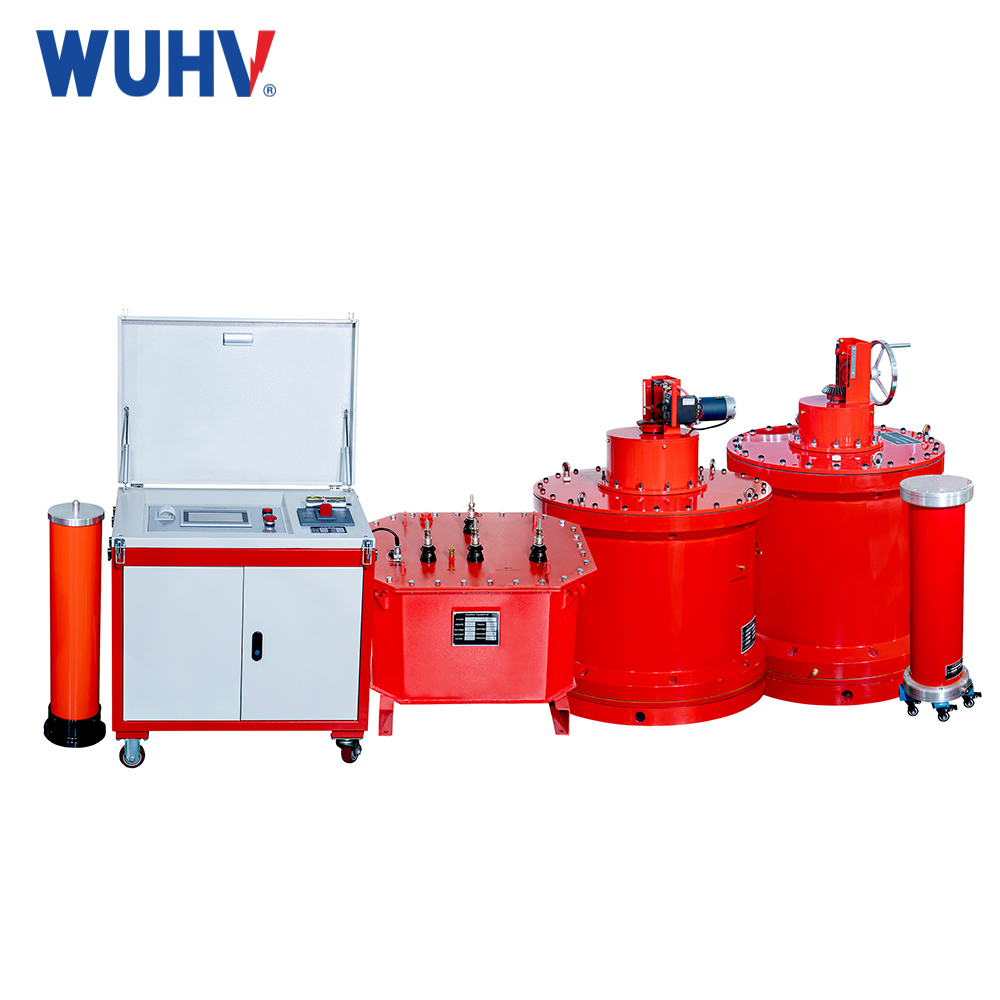
The principle of series resonance? Wuhan UHV specializes in the production of series resonance, with a wide range of product selection and professional electrical testing. To find series resonance, choose Wuhan UHV.

The variable frequency series resonance test device, also known as series resonance, is composed of a variable frequency power supply, excitation transformer, reactor, and capacitive voltage divider. The capacitor and reactor of the test sample form a series resonant connection; The voltage divider is connected in parallel to the test sample to measure the resonant voltage on the test sample and provide an overvoltage protection signal; The frequency modulation power output is coupled to the series resonant circuit through an excitation transformer, providing excitation power for series resonance.
The principle of series resonance
Use an excitation transformer to excite a series resonant circuit, adjust the output frequency of the variable frequency controller, and make the circuit inductance L and the test sample C resonate in series. The resonant voltage is the voltage applied to the test sample.
We know that when the circuit frequency f=1/2 π√ LC, resonance occurs in the circuit, and the voltage on the test sample is Q times the output voltage of the excitation transformer high voltage end. Q is the system quality factor, which is the voltage resonance multiple, generally ranging from tens to hundreds or more. First, adjust the output frequency of the variable frequency power supply to induce series resonance in the circuit, and then adjust the output voltage of the variable frequency power supply under the condition of circuit resonance to achieve the test value of the sample voltage. Due to the resonance of the circuit, a smaller output voltage of the variable frequency power supply can generate a higher test voltage on the test sample CX.
Application of series resonance
Series resonance is widely used in industries such as power, metallurgy, petroleum, and chemical engineering, and is suitable for the handover and preventive testing of high-capacity, high-voltage capacitive specimens.
Series resonant devices are mainly used for the following purposes:
1. AC voltage withstand test of 6kV-500kV high-voltage cross-linked cable
2. AC voltage withstand test of generator
3. AC withstand voltage test for GIS and SF6 switches
4. Power frequency withstand voltage test of 6kV-500kV transformer
5. AC withstand voltage test for other high-voltage electrical equipment such as busbars, bushings, and transformers.
In an AC circuit with resistor R, inductor L, and capacitor C, series resonance generally results in different phases of voltage and current at both ends of the circuit. If we adjust the parameters or power frequency of circuit components (L or C), we can make their phases the same, and the entire circuit appears purely resistive. When a circuit reaches this state, it is called resonance. In the resonant state, the total impedance of the circuit reaches or approximates its maximum value. The purpose of studying resonance is to understand this objective phenomenon and fully utilize its characteristics in science and applied technology, while also preventing the harm it may cause. According to the different circuit connections, there are two types: DAXZ series series series resonance and parallel resonance. In a series circuit composed of resistors, inductors, and capacitors, when the capacitive reactance XC is equal to the inductive reactance XL, i.e. XC=XL, the phase of the voltage U and current I in the circuit are the same, and the circuit exhibits pure resistance. This phenomenon is called series resonance (also known as voltage resonance). When a series resonance occurs in the circuit, the impedance of the circuit Z=√ R2+XC-XL2=R, the total impedance in the circuit is minimized, and the current will reach its maximum value.