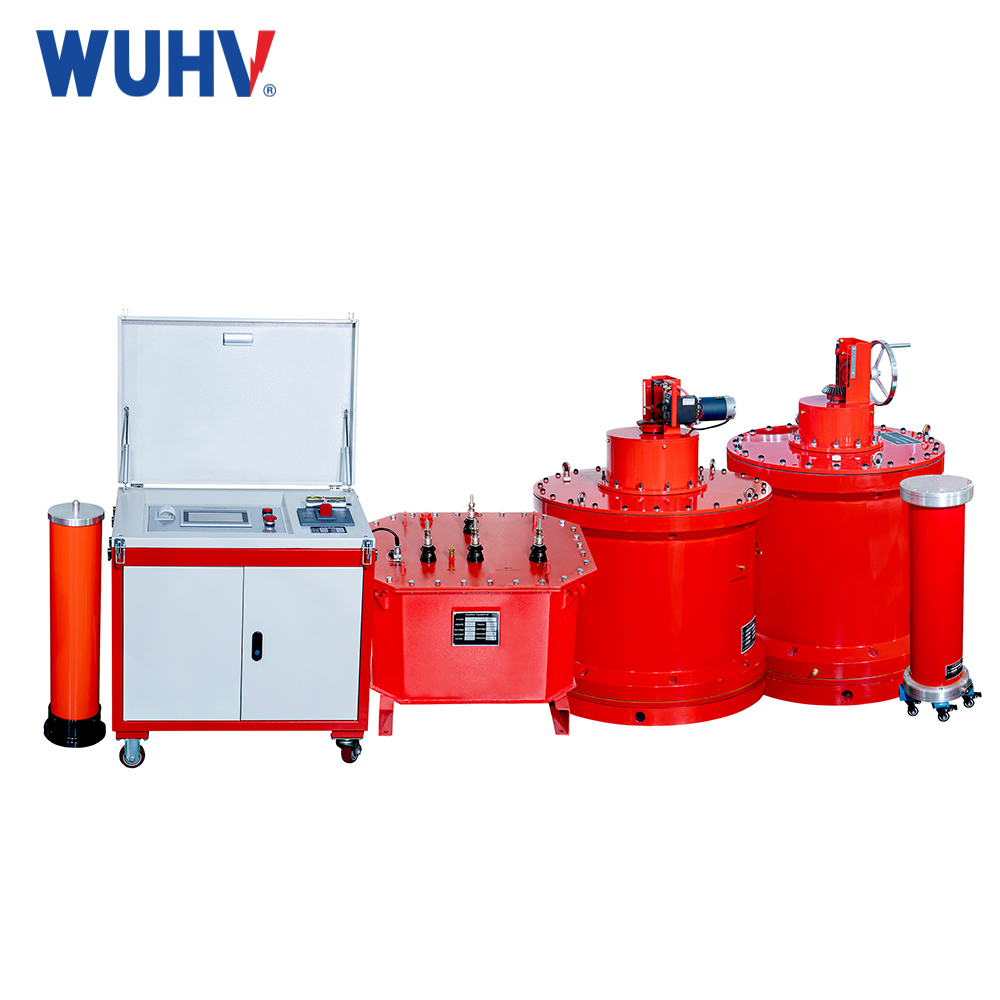
Analysis of LC series resonant circuit? Wuhan UHV specializes in the production of series resonance, with a wide range of product selection and professional electrical testing. To find series resonance, choose Wuhan UHV.

Analysis of LC series resonant circuit
The understanding method of impedance characteristics during resonance and the analysis of the working principle of LC series resonant circuit need to be divided into three frequency points and bands, namely resonance, input signal frequency higher than the resonance frequency, and input signal frequency lower than the resonance frequency.
When the input signal frequency is equal to the resonant frequency, the circuit resonates, and the impedance of the LC series resonant circuit is in the minimum state, which can be equivalent to a pure resistor. At this time, the signal current flowing through the entire resonant circuit is at its maximum.
The understanding method of impedance characteristics when the circuit is detuned: When the input signal frequency is higher or lower than the resonant frequency, the LC series circuit is in a detuned state, and the circuit impedance is larger than that when it is in resonance.
Analysis of the Working Principle of LC Resonant Circuit
(1) Master the impedance characteristics. Understanding some of the main characteristics of these two resonant circuits is the basis for analyzing their application circuits, among which the most important is the impedance characteristics of the two resonant circuits, because in the analysis of the working principles of various circuits, the analysis of the circuit is mainly based on the impedance of the circuit. When the LC parallel resonant circuit resonates, the impedance is the highest, while the LC series resonant circuit is the lowest. It is easier to remember to correspond them.
(2) The LC series resonant circuit has the minimum impedance during resonance. The precautions to be taken when analyzing LC series resonant circuits are the same as those for parallel resonant circuits, except that the impedance of the circuit is minimized during series resonance and maximized during parallel resonance.
For LC series resonant circuits, when the circuit is detuned, the impedance of the circuit is large. At this time, for signals with frequencies lower than the resonant frequency, the main reason is that the capacitance impedance of capacitor Cl is large. For signals with frequencies higher than the resonant frequency, the main reason is that the inductance impedance of inductor Ll is large.
(3) When the LC parallel resonant circuit loses resonance, the impedance is small. For LC parallel resonant circuits, when the circuit is detuned, the impedance of the circuit is very small. At this time, signals with frequencies lower than the resonant frequency mainly pass through the inductor Ll branch, while signals with frequencies higher than the resonant frequency mainly pass through the capacitor Cl branch.
(4) The input signal frequency is divided into two situations. When analyzing the application circuits of these two LC resonant circuits, the input signal frequency should be divided into two situations: the circuit operation when the input signal frequency is equal to the resonant frequency and the circuit operation when the input signal frequency is not equal to the resonant frequency.
(5) Damping resistor effect. The purpose of adding damping resistors in parallel resonant circuits is to obtain the required bandwidth. The smaller the resistance value of the added resistor, the wider the frequency band, and vice versa.
The frequency of the signal input to the LC parallel resonant circuit is very wide, including signals with frequencies equal to the resonant frequency. Among numerous input signals of different frequencies, the circuit only resonates with signals at the resonant frequency, at which point the impedance of the circuit is at its maximum. A resonant circuit has a bandwidth. In circuit analysis, it can be considered that signals within the frequency band are amplified or processed in the same way as signals at the resonant frequency; But for signals with frequencies deviating from the resonant frequency, it is important to understand. The width of the frequency band is related to the size of the Q value. If the Q value is large, it is considered that it has not been amplified or processed, which is why circuit analysis requires a narrow frequency band; Small Q value and wide frequency band.
Characteristics of LC series resonant circuit
1. The current and voltage have the same phase, and the circuit is resistive.
2. The series impedance is minimized and the current is maximized: at this point, Z=R, then I=U/R.
3. The voltage at the inductor end is equal in magnitude to the voltage at the capacitor end, opposite in phase, and compensates for each other. The voltage at the resistor end is equal to the power supply voltage.
4. The ratio of the voltage at the inductor (capacitor) terminal to the power supply voltage during resonance is called the quality factor Q, which is also equal to the ratio of the inductance (or capacitance) to the resistance. When Q>>1, the voltage on L and C is much higher than the power supply voltage (similar to resonance), which is called series resonance and is commonly used for amplifying signal voltage; But series resonance should be avoided in the power supply circuit.