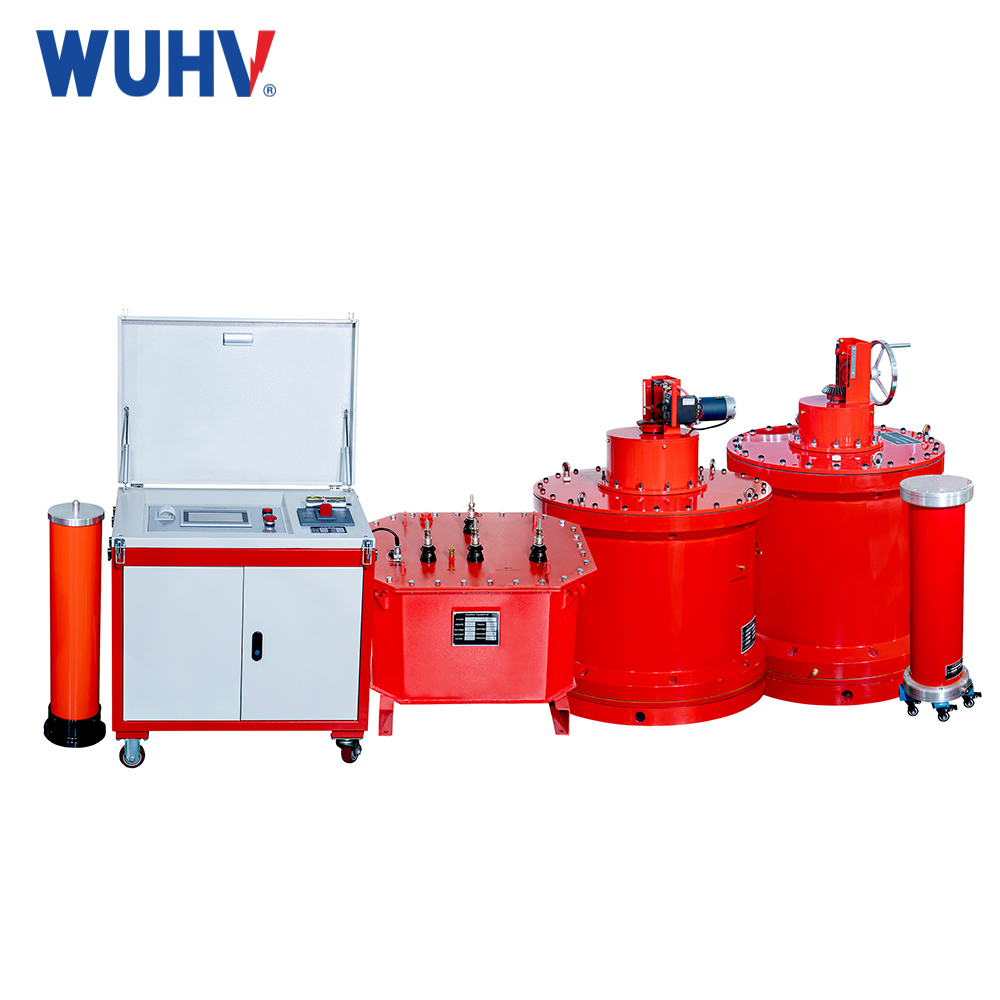
Series and parallel resonance? Wuhan UHV specializes in the production of series resonance, with a wide range of product selection and professional electrical testing. To find series resonance, choose Wuhan UHV.
Difference between series and parallel resonance
In a series circuit of resistors, capacitors, and inductors, the phenomenon of power supply, voltage, and current being in phase occurs, which is called series resonance. Its characteristics are: the circuit is purely resistive, the power supply, voltage, and current are in phase, the reactance X is equal to 0, and the impedance Z is equal to the resistance R. At this time, the impedance of the circuit is the smallest and the current is the largest, which may generate high voltage on the inductor and capacitor that is many times larger than the power supply voltage. Therefore, series resonance is also known as voltage resonance.
The resonance voltage is superimposed with the original voltage, and parallel resonance: In parallel circuits of resistors, capacitors, and inductors, the phenomenon of the circuit terminal voltage and total current being in phase is called parallel resonance. Its characteristics are that parallel resonance is a complete compensation, and the power supply does not need to provide reactive power, only the active power required by the resistor. During resonance, the total current of the circuit is minimized, and the branch current is often greater than the total current in the circuit. Therefore, parallel resonance is also called current resonance.
Characteristics of series and parallel resonance
In a series circuit of resistors, inductors, and capacitors, the phenomenon where the terminal voltage of the circuit is in phase with the total current of the circuit is called series resonance.
The characteristics of series resonance are that the circuit is purely resistive, with the terminal voltage and total current in phase. At this time, the impedance is the smallest and the current is the largest, which may generate high voltages on the inductance and capacitance that are many times greater than the power supply voltage. Therefore, series resonance is also known as voltage resonance.
In power engineering, due to the occurrence of overvoltage and high current caused by series resonance, which can damage electrical equipment, it is necessary to avoid series resonance.
In a circuit where an inductor is connected in parallel with a capacitor, the phenomenon of parallel resonance occurs where the terminal voltage of the parallel circuit is in phase with the total current of the circuit.
The total impedance of a parallel resonant circuit is the highest, resulting in the minimum total current of the circuit. However, for each branch, its current may be much larger than the total current, so current resonance is also known as current resonance.
Parallel resonance will not generate resonance overvoltage that endangers equipment safety, but each branch will generate overcurrent.
Principle of series resonance
The principle of series resonance is a series circuit composed of resistors, inductors, and capacitors. Under the action of a sine voltage with an external angular frequency of ω, the inductive and capacitive impedances in the R, L, and C series circuits compensate for each other. When the inductive and capacitive impedances are not equal, the impedance angle ≠ 0, and the circuit is capacitive (XC>XL) or inductive (XC<XL); The current, leading voltage, or lagging voltage in a circuit. If the angular frequency ω and the L and C parameters of the circuit satisfy certain conditions to fully compensate for the inductive and capacitive reactance, i.e. XL=XC, then the reactance of the circuit X=XL - XC=0. At this time, the impedance angle of the circuit is 0, and the current and voltage in the circuit will be in phase. This state of the circuit is called resonance, and the resonance frequency f=1/2 π LC is derived from it. Because it occurs in a series circuit, it is called series resonance.
Parallel resonance principle
In an oscillating circuit where inductance, capacitance, and an external AC power source are connected in parallel, the inductance coil is usually represented by a series combination of resistance and inductance. The losses and leakage currents of capacitors are generally small and can be ignored under certain conditions, as shown in the figure. If the inductance and capacitance of the circuit are much larger than the resistance, that is, ω L (ω C)>>R, the natural frequency of the parallel circuit can be approximated as f=1/2 π LC. If Q, L, and C meet certain conditions to make the inductance and capacitance of the parallel circuit equal, BL=BC (BL=ω L, BC=1/ω C), so that the admittance B is equal to zero (B=BL - BC=0), then the current and voltage will be in phase (ω=0), which is called R, L, and C parallel resonance.