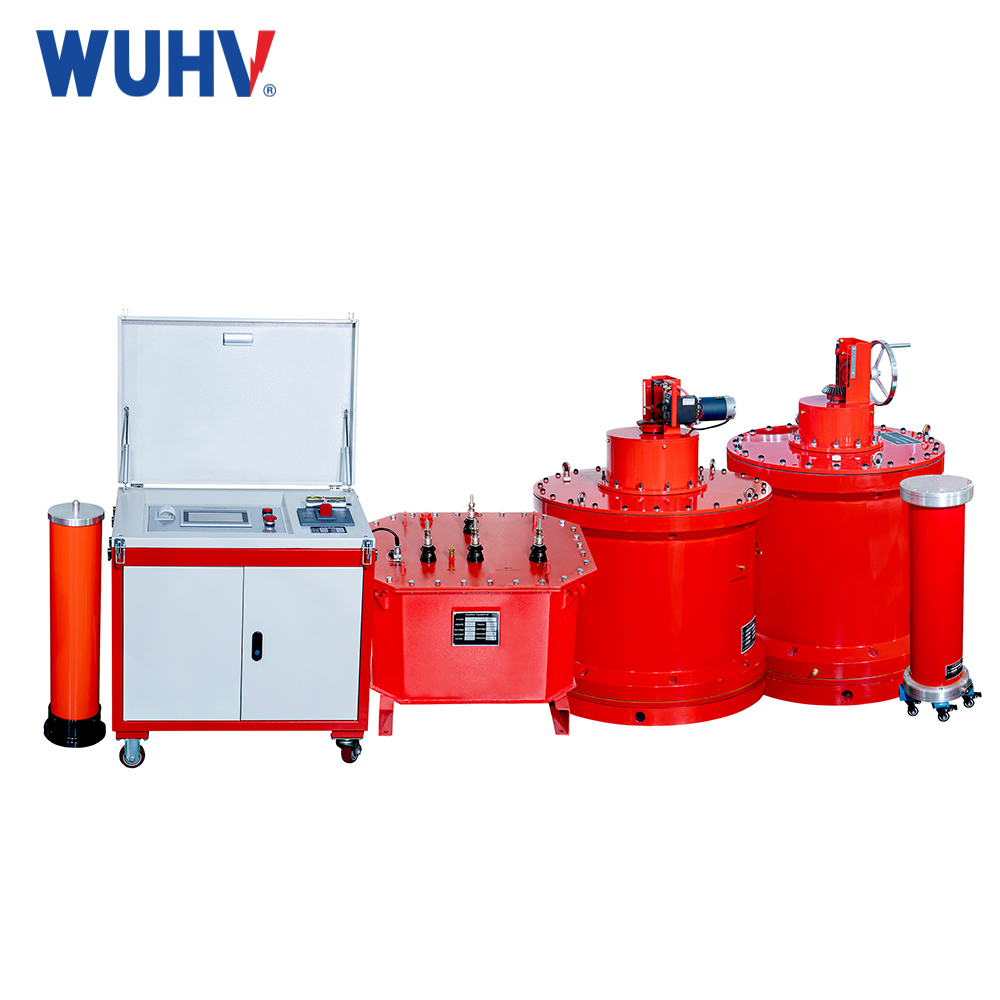
System ferromagnetic resonance? Wuhan UHV specializes in the production of series resonance, with a wide range of product selection and professional electrical testing. To find series resonance, choose Wuhan UHV.
Ferroresonance is a resonance condition formed by iron core inductive components such as generators, transformers, voltage transformers, reactors, arc suppression coils, and system capacitive components such as transmission lines and capacitance compensators, which excite sustained ferromagnetic resonance and generate resonant overvoltage in the system. Resonant overvoltage accidents are the most frequent and can occur in power grids of various voltages, seriously affecting safe operation in the power grid. The main hazards of ferromagnetic resonance include system overvoltage, insulation breakdown, PT burnout, and lightning arrester explosion.
The ferromagnetic resonance in the power system can be divided into two categories: one is the phenomenon of ferromagnetic resonance induced by the unfavorable combination of ground capacitance reactance and electromagnetic voltage transformer excitation inductance reactance in the neutral point non directly grounded power grid of medium and low voltage levels, under the action of system voltage disturbance, that is, parallel resonance. It is an internal overvoltage that causes many accidents, ranging from fuse failure to equipment burnout; Another type is the ferromagnetic resonance phenomenon caused by the transient operation of the electromagnetic voltage transformer group connected to the live magnetic voltage transformer during the charging process of the empty busbar of the live magnetic voltage transformer using a 220kV or 110kV main switch or bus tie switch with a break voltage equalizing capacitor, or when cutting off the empty busbar with an electromagnetic voltage transformer.
System ferromagnetic resonance phenomenon:
1. Fundamental resonance. Overvoltage is less than or equal to 3 times the phase voltage, one phase voltage drops (not 0), and the two phase voltages rise greater than the phase voltage; Or if the voltage of two phases drops (not to 0), the voltage of one phase increases, and the line voltage is normal. There is a grounding signal. The resonant overcurrent is significant.
2. High harmonic resonance. If the overvoltage is less than or equal to 4 times the phase voltage and the three phase to ground voltage rise together, it is much greater than the phase voltage, and the line voltage is normal. There is a grounding signal. The resonant overcurrent is relatively small.
3. Sub harmonic resonance. Overvoltage is less than or equal to twice the phase voltage. The three-phase to ground voltage increases alternately in phase sequence, generally oscillating at a low frequency of 1.2 to 1.4 times the phase voltage, about once per second, and the line voltage is normal. There is a grounding signal. The resonant overcurrent is significant.
Characteristics of ferromagnetic resonance in the system:
1. The iron core inductance in a resonant circuit is nonlinear, and the inductance tends to stabilize with increasing current and iron core saturation.
2. Ferromagnetic resonance requires certain excitation conditions to transition the voltage and current amplitudes from the normal operating state to the resonant state.
3. Resonance exhibits a self-sustaining phenomenon, and even after the excitation factor disappears, the ferromagnetic resonance overvoltage can continue to exist for a long time.
4. The overvoltage of ferromagnetic resonance is generally not very high, and the amplitude of the overvoltage mainly depends on the saturation degree of the iron core inductance.
Analysis of the causes of ferromagnetic resonance in the system:
In simple R, C, and iron core inductance L circuits, assuming that under normal operating conditions, the initial state is where the inductive reactance is greater than the capacitive reactance, i.e., ω L>(1/ω C), there is no linear resonance condition, and the circuit remains in a stable state. But when the power supply voltage increases or there is inrush current in the inductor coil, it is possible to saturate the iron core and reduce its inductance value. When ω L=(1/ω C), the series resonance condition is met, and overvoltage is formed at both ends of the inductor and capacitor. The phase and amplitude of the circuit current will suddenly change, causing magnetic resonance phenomenon. Once resonance is formed, the resonance state may "self maintain" and maintain for a long time without attenuation until encountering new interference that changes its resonance condition. Resonance can only be eliminated.
The conditions for the generation of ferromagnetic resonance in the power system:
Many components in the power system are inductive or capacitive, such as power transformers, transformers, generators, and arc suppression coils as inductive elements, parallel or series capacitors used for compensation, and parasitic capacitors of high-voltage equipment as capacitive elements. However, there are both longitudinal and transverse inductances between the wires of the line and the ground, and these components form complex LC oscillation circuits. Under certain energy sources, resonance phenomena will occur in circuits with specific parameter combinations. Due to the nonlinear relationship between the magnetic flux and current of the iron core inductor, an increase in voltage can cause the iron core inductor to become saturated, which can easily lead to ferromagnetic resonance in the voltage transformer. In a neutral ungrounded system, if the active losses and phase capacitance of the line are not considered, and only the inductance L of the voltage transformer and the ground capacitance Co of the line are considered, when C reaches a certain value and the voltage transformer is not saturated, the inductance XL is greater than the capacitance XCo. When the voltage on the voltage transformer rises to a certain value, the iron core of the voltage transformer saturates, and the inductive reactance XL is smaller than the capacitive reactance XCo, thus forming the resonance condition.
The impact of ferromagnetic resonance on the safe operation of power systems:
1. In a neutral point ungrounded system, the main characteristic of its operation is that after single-phase grounding, it is allowed to maintain a certain period of time, usually 2 hours, without causing power outage to the user. But with the expansion of the medium and low voltage power grid, the number of outgoing circuits increases, the number of lines grows, and the number of cable lines gradually increases. The capacitance current of the medium and low voltage power grid to ground also increases significantly. When the grounding arc cannot be automatically extinguished during single-phase grounding, it will inevitably produce arc overvoltage, which is generally 3-5 times the phase voltage or even higher. This will cause electrical breakdown in weak insulation areas of the power grid, and under the action of overvoltage, it is easy to cause the second point grounding to develop into phase to phase short circuit, causing equipment damage and power outage accidents, seriously threatening the safe operation of the power grid.
2. When resonance occurs, the primary excitation current of the voltage transformer increases sharply, causing the high-voltage fuse to melt. If the current has not yet reached the melting value of the fuse, but exceeds the rated current of the voltage transformer and operates under overcurrent conditions for a long time, it will inevitably cause the voltage transformer to burn out.
3. Due to the overvoltage generated after resonance, it may cause insulation breakdown of equipment, resulting in burning, and may also cause lightning arrester explosions.
4. Generating high zero sequence voltage components, resulting in false grounding and incorrect grounding indications, may cause erroneous judgments by substation operators, leading to incorrect handling decisions and unnecessary losses.