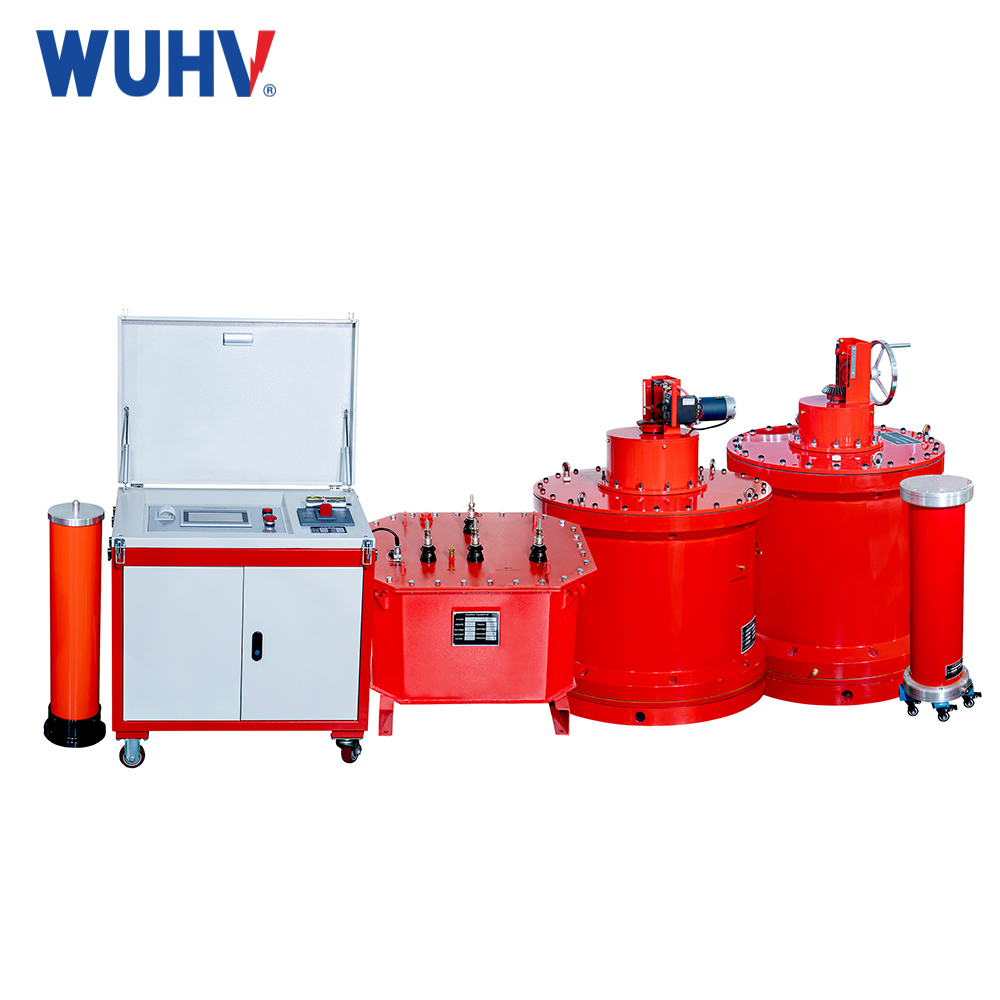
The principle of resonant circuit? Wuhan UHV specializes in the production of series resonance, with a wide range of product selection and professional electrical testing. To find series resonance, choose Wuhan UHV.
A resonant circuit is composed of an inductor, a capacitor, and a resistor. In an RLC series circuit, if a sine AC signal source with a constant output voltage amplitude and continuously adjustable output frequency f is connected, many parameters in the circuit will change with the frequency of the signal source. That is, the circuit impedance Z, the loop current I, and the phase difference between the current and the signal source voltage φ are
Z=[R2+(ZL-ZC)2]1/2=[R2+(ωL-1/ωC)2]1/2
I=U/Z=U/[R2+(ωL-1/ωC)2]1/2
φ=arctan[(ωL-1/ωC)/r]
In the above three equations, the angular frequency of the signal source is ω=2 π f, the capacitance impedance Zc=1/ω C, and the inductance ZL=ω L, and each parameter changes with the variation of ω
When ω is very small, the total impedance of the circuit is Z=[R2+(1/ω C) 2] 1/2, and the phase of the current from π→π/2 leads the signal source voltage phase. The entire circuit is capacitive; When ω is large, Z=[R2+(ω L) 2] 1/2, π→π/2, the current phase lags behind the signal source voltage phase, and the entire circuit is inductive; When the capacitive impedance equals the inductive impedance and cancels each other out, the total impedance of the circuit Z=R is the minimum value. At this time, the circuit current is the maximum value Imax=U/R, and the phase difference φ=0. The entire circuit is resistive, and this phenomenon is called resonance. The frequency fo at which resonance occurs is called the resonance frequency, and the angular frequency ω o is called the resonance angular frequency. The relationship between them is
ω=ω 0=(1/LC) 1/2 or fo=ω 0/2 π=1/[2 π (LC) 1/2]
During resonance, the ratio of the voltage UL on inductor L to the output voltage U of the signal source is Q, which is called the quality factor of the circuit. Q reflects the inherent properties of the resonant circuit.
Q=ZL/R=ZC/R=UL/U=UC/U=1/ω0RC=ω/R=1/R(L/C) 1/2
It can be seen that both UL and Uc are Q times the power supply voltage U. Usually, Q>>1, so UL or Uc can be much larger than U. Therefore, series resonance is called voltage resonance.
The Q value also indicates the frequency selectivity of the circuit, that is, the sharpness of the resonance peak. Usually, it is stipulated that the current I value is half of its maximum value, and the difference in frequency between the two points of half is Δ f=f2-f1, which is the "passband width"
According to this definition, it can be inferred that
Δf=f2-f1=fo/Q
Obviously, the larger the Q value, the smaller the direct bandwidth Δ f, and the sharper the resonance curve; The opposite is true. This indicates that the stronger the frequency selection performance of the circuit, the larger the Q value and the greater the current!